Lifelong Learning Summit Delivers Inspiration, Exploration
An eclectic, daylong educational seminar focused on emerging technologies, real-world solutions for accounting professionals.
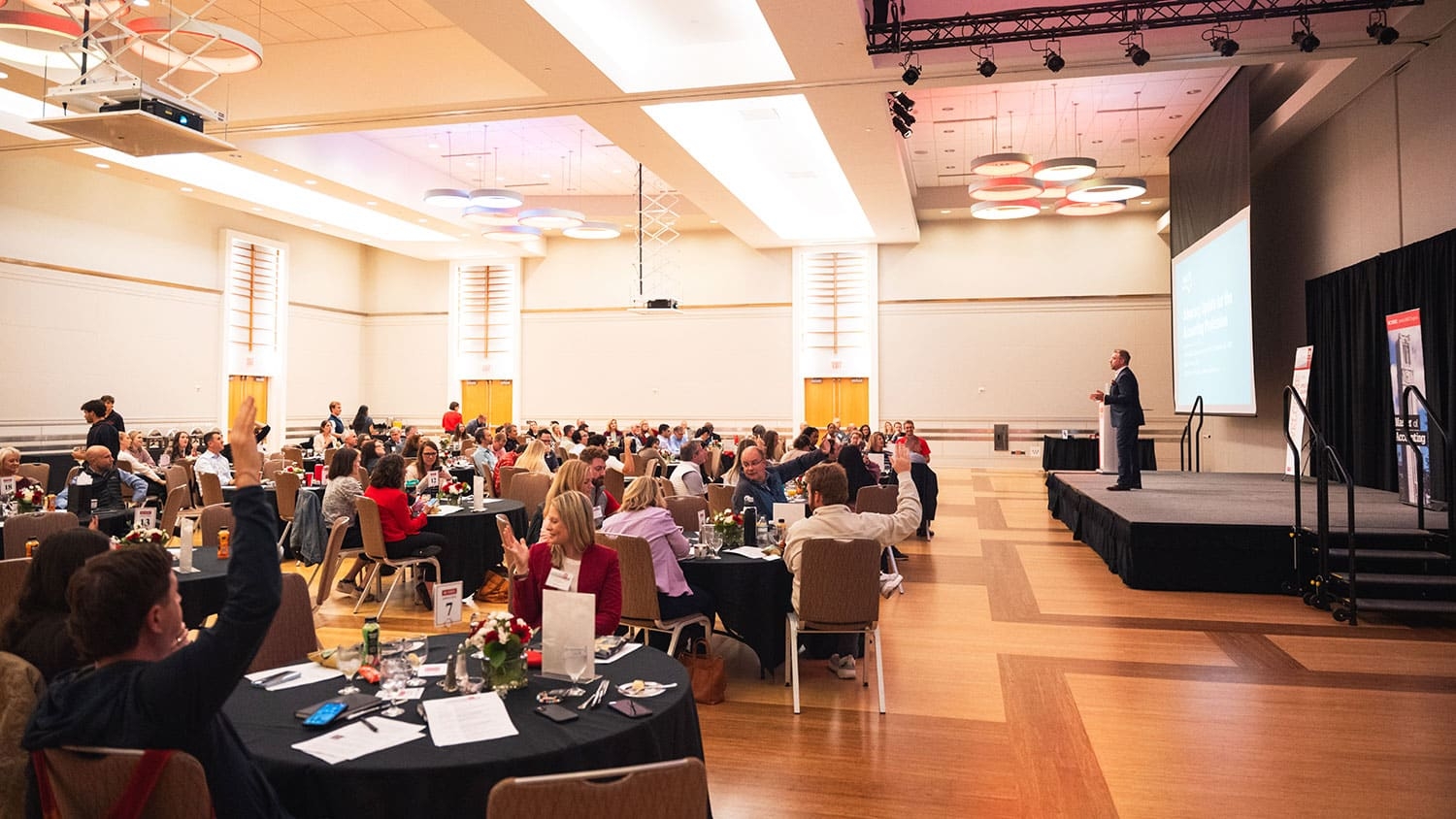
The 150 accounting professionals seated around tables in a ballroom at NC State’s Talley Student Union in late September were meeting in a time of uncertainty. A federal government shutdown — just days away — seemed inevitable. State legislators remained deadlocked on a budget, stalling a crucial bill needed to update the state’s tax code to conform with new federal laws. Vague, rapidly changing tariff and trade policies had begun to cut into corporate profits and dampen hiring. Even the weather seemed uncertain, as storm clouds gathered overhead throughout the afternoon.
At the back of the room, Scott Showalter surveyed the scene with a perspective gained from nearly five decades in the accounting profession. A perspective that allowed him to look to the future with confidence, knowing that whatever problems the world faced, accountants would be in high demand to help find solutions.
“There is absolutely no industry you cannot go into with an accounting degree,” he said. “Think about every industry out there — technology, health care, finance, entertainment, nonprofits —they all require accounting. And a lot of positions are directly related to accounting, from entry-level roles to tax directors, auditors and CEOs.”
Showalter is a CPA and director of the Jenkins Master of Accounting (MAC) Program at NC State. In an uncertain world the MAC program offers the closest thing to a sure bet you can find: For three years running, 100% of students have secured a job within three months of graduation; 95% have job offers by the end of their first semester.
The event at the Talley Student Union was the program’s fourth annual Lifelong Learning Summit, bringing together students, alumni and other accounting professionals for an eclectic mix of information, inspiration and exploration.
People Power
First on the agenda was a panel of three NC State alumni sharing their experiences as social entrepreneurs. If there was a common theme for the panel, it was the power of personal connections.
“Find one person who believes in you and believe them,” said Sydney Loflin, an event and advocacy coordinator for the BASF Center for Sustainable Agriculture and co-author of Focused as a Bee: Six Buzzworthy Strategies To Thrive in a Distracting World.
Loflin’s entrepreneurial journey began at age 9 with a home baking business that started as a 4-H project. With her mother’s support, she learned to navigate the challenges of running and growing a business, from getting a tax ID number to having her kitchen USDA-inspected. Her journey continues at NC State, where she’s earning a master’s degree in agriculture, concentrating on youth, family and community sciences.
Jess Ekstrom also launched her own business at a young age. During an internship at the Make-A-Wish Foundation while she was a student at NC State, she noticed that children losing their hair to chemotherapy wanted to restore their self-confidence, not just cover their heads. That inspired her to start Headband of Hope, a company that donates a headband to a child with an illness for every headband it sells. She launched a second company, Mic Drop, to help women become confident public speakers.
“There is absolutely no industry you cannot go into with an accounting degree.”
Ekstrom now finds more fulfillment in empowering other women than in achieving personal milestones. “What if our success in our job and our role in our profession wasn’t necessarily about how far we can reach individually,” she asked the audience. “By helping others, it becomes less lonely, more fun, and frankly more scalable.”
The third panelist, Dena McDonald, tapped into a community of entrepreneurs to grow her business, a marketing collective called Choose Local and Small Y’all (CLASY). What began as an innovative effort to help small companies survive during the COVID-19 pandemic has evolved into a powerful small-business alliance.
“We really are all interconnected,” she said. “Life really is about helping each other through the journey.”
Managing Risk
The day’s second presentation, by Keith Goad, linked the power of community to the challenges of managing risk in a volatile world. Goad, chief financial officer for Builders Mutual, counted down the chain of disasters that have upended the economy over the past five years, from the pandemic and supply-chain disruptions to the increasing frequency of storms and the growing threat of cyber attacks.
As an insurance executive, Goad had the numbers at his fingertips. “We’ve had successive years with 30 or more catastrophic events costing over $1 billion each,” he told the audience. “That’s the highest amount on record.”
This environment has created what Goad calls the “resiliency paradox.” While we seem to be in an era of “unique and extreme risks,” he said, “we have also never been more prepared to be collectively resilient as they emerge.”
Goad led the audience in an exercise demonstrating the wisdom of crowds. Individually, no one person in the room could answer a series of Jeopardy-style questions. But, as a group, they had no trouble finding the answers.
“Collectively you have all the power and the answers,” Goad said.
Juggling Elephants
Career coach Jones Loflin, author of Juggling Elephants, told the audience they could learn lessons on managing work-life balance from the circus. Just like a circus ringmaster manages a variety of acts spread across three rings, Loflin advised attendees to visualize their daily activities divided into three priority areas: work, self and relationships.
To avoid being overwhelmed by the constant calls on their attention, attendees should use a strategy Loflin called “TAD,” short for Transfer, Automate, Drop. Tasks that can be easily delegated to others should be transferred, routine tasks should be automated and those that are nonessential should be dropped, he said.
“The goal isn’t to eliminate every challenge, but to manage them effectively by focusing on what truly matters,” he said.
Client-Centered Mindset
Alumnus Michael Zimmerman Jr., who shared his career highlights with Showalter and the audience over lunch, said the key to his success was emulating leaders “who lead from the front.” Zimmerman, director of business development at Audit Sight Inc., formerly worked as a senior manager at “Big 4” accounting firm EY.
“When I return to NC State and speak with students, I always emphasize the value of having a client-centered mindset,” he said. “Being able to put yourself in your client’s shoes, to know what they’re going through, is super important. You build a lot of great relationships that way.”

AI: Hype or Help?
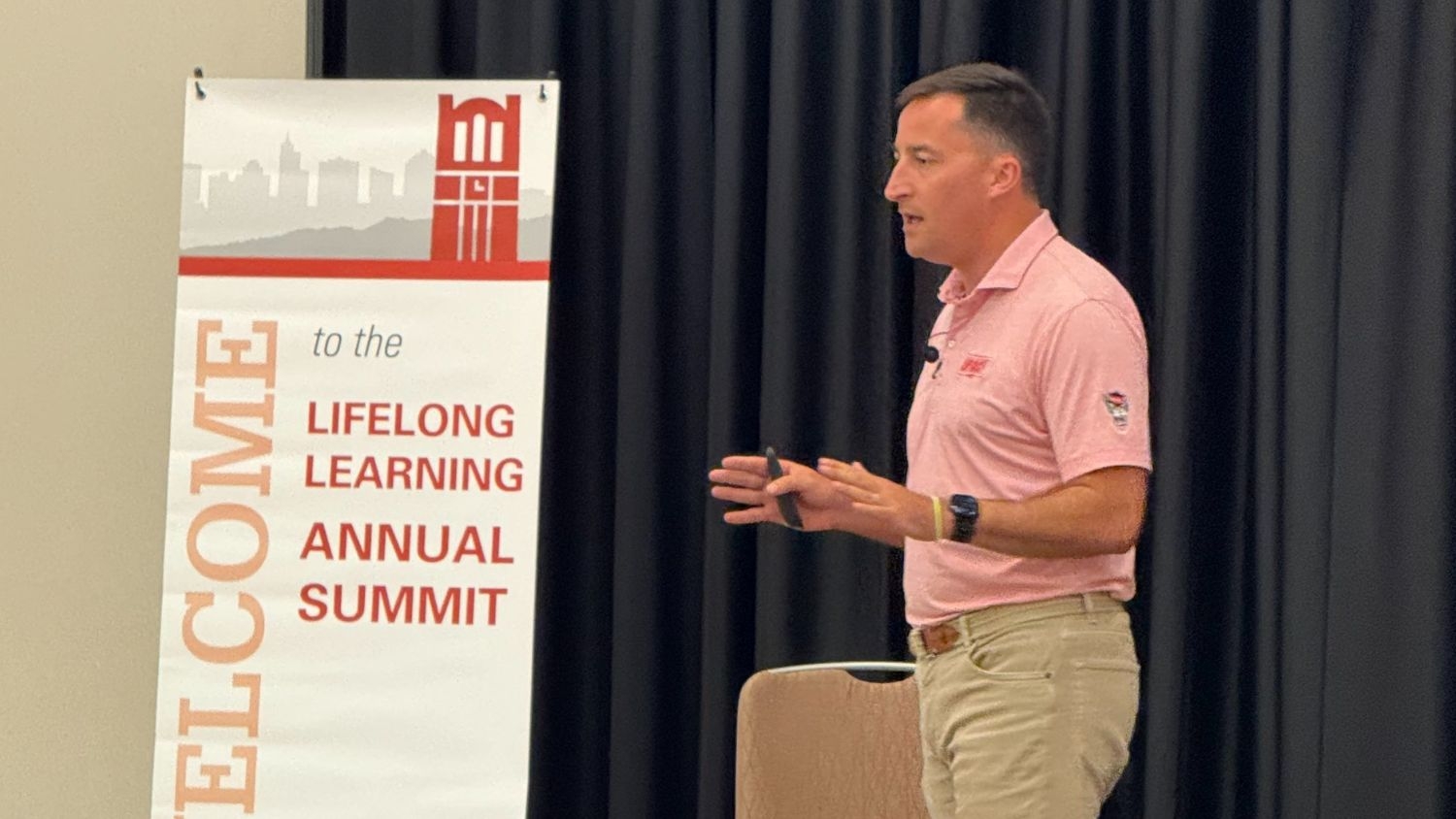
Jonathan Kraftchick, a partner at Cherry Bekaert Advisory LLC, explored the complex relationship between artificial intelligence and the accounting profession. Historically, he noted, new technologies like the invention of the spreadsheet shifted the accountant’s role from bookkeeping to analysis. AI is now triggering a similar, but much faster, transformation, he said.
Kraftchick quoted futurist Alvin Toffler, who said, “The illiterate of the future will not be those who cannot read and write, but those who cannot learn, unlearn, and relearn.”
The key to navigating the advent of AI is not just adopting new tools but fundamentally rethinking and redefining the value that humans bring to their work, Kraftchick explained. He encouraged accounting professionals to use AI as a tool to expand their thinking and explore new possibilities. For organizations to succeed, they must first focus on fundamentals like data standardization and process automation before diving into AI, he said.
NIL: Now What?
Chris Vurnakes, executive director of 1PACK NIL, discussed how college athletics has changed since 2021, when the Supreme Court opened the door for student-athletes to legally earn money from their name, image and likeness, or NIL.
At NC State, 1PACK NIL facilitates opportunities like autograph signings, fan meet and greets, corporate opportunities and branded deals, and has distributed over $2 million to student-athletes in the past two years.
Vurnakes said he advocates giving student-athletes a seat at the table to negotiate directly with the NCAA, creating a more stable and equitable long-term plan for college athletics.
Legislative Update
Robert Broome, vice president of advocacy and outreach for the North Carolina Association of Certified Public Accountants, discussed recent political and legislative issues impacting the accounting profession at both the federal and state levels.
Key wins included:
- Preserving the itemized state and local tax (SALT) deduction in the federal tax code for pass-through entities, protecting the workaround established in North Carolina.
- Expanding the use of 529 plans to cover expenses for post-secondary credentials like the CPA exam, licensing fees and continuing education.
- Preventing a proposed change in the tax code that would have allowed for unregulated contingency fee arrangements for tax preparers.
A federal government shutdown would be highly concerning for the accounting profession, Broome said, especially with the Oct. 15 tax deadline nearing. The situation is compounded by severe staffing shortages at the IRS, which has lost a quarter of its workforce since January.
Ethics and the Human Element
The final presentation of the day, by Hunter Cook of the North Carolina Association of Certified Public Accountants, focused on ethics.
Cook challenged two traditional presumptions about compliance: that employees will automatically follow orders just because an employer has the right to give them, and that behavior can be effectively controlled solely through incentives and punishments. These approaches are flawed because they ignore the human element, he said.
“If you’re going to make rules, you have to understand how people make decisions,” he said.
People are not always rational, he noted. They are influenced by cognitive biases, limited knowledge and a desire to belong to a group. To create a better compliance environment, Cook urged the audience to focus not on what they want people to do, but on “what they are likely to do.” The goal is to get inside employees’ heads and design rules that align with their natural tendencies and address their core concerns, such as job security and finding meaning in their work.

At the end of the summit, Showalter, the MAC program director, said the event surpassed expectations, and he praised the speakers for “hitting it out of the park.”
“Just watching the reaction in the audience and the engagement that we had with the participants, I think every speaker resonated with the audience,” he said.
Showalter said the event intentionally emphasized new and unique topics like AI and social entrepreneurship to give attendees insights into some of the profession’s most pressing issues. “When we talk about lifelong learning for the accounting profession, we realize that there are a lot of things in life that aren’t just about accounting issues or tax policy,” he said. “So, we deliberately focused on things you wouldn’t learn in a typical professional development event. That’s kind of our mantra.”
To learn more about the MAC program in the Poole College of Management, visit https://mac.ncsu.edu.
This post was originally published in Poole College of Management News.
- Categories: